CHINA Edition
 Hungarian Edition


In an era where visual storytelling has the power to shape perspectives and ignite conversations, few are as committed to this craft as Júlia Cristescu Bodó. Beginning her filmmaking career in post-production, Julia has evolved into a multifaceted talent with her hands in various pots of the film and television industry.
Now, at the core of her work is an unyielding focus on the art of set and production design, bringing stories to life through meticulous attention to detail. We sat down with Julia to delve into her latest projects, her approach to both Hungarian and international projects, and what she envisions as the future of production design in the world of cinema.
BPR: How did you get into the film industry? Did you always want to be a production designer?
Júlia Bodó: Initially, I was uncertain about what path I wanted to take. My mother is a painter, so I had some exposure to arts, but I never considered myself a creative person. I did study drawing, but I lacked the confidence to commit to an artistic career. Eventually, I enrolled in a design program in Strasbourg. I discovered that I actually enjoy and excel at drawing and conceptualising projects. After completing my design degree, I was still unsure of my next steps. One thing came after another, and I found myself enrolled in a film directing program at the Romanian University of Cinematic Arts.
After my studies, I entered the Budapest film scene as an assistant editor, thanks to my then-partner who was an editor. I learned how to use the softwares, so I worked in post-production for almost two years. I was able to get an inside look into serious productions, but eventually found my way back to the art department via an internship advert for Prop Club, a Hungarian set design company. During the initial interview, they redirected me to Judit “Csuti” Varga, the owner of the company. After a conversation with her, I received my first assignment within an hour and was fully immersed in design work from then on. For two years, I worked on a series of projects, including advertisements, series and films. This gave me a wide range of experiences and accelerated my growth in the field.
My first real breakthrough was when I got a job on Netflix‘s “Barbarians”, where under the guidance of German designer Thomas Stammer I had the opportunity as assistant set decorator to design some of the set pieces. In Hungary, it’s usually the art directors who design individual elements, but working with a foreign designer who had different expectations was a valuable experience. This way, even as an assistant set decorator I ended up sketching furniture for the Barbarians, which was very exciting. The connections I made during that production opened doors to roles in art direction, ultimately leading me to opportunities as a production designer.
BPR: What does your creative process look like from start to finish?
J. Bodó: Typically, I’m approached by the producers of the project, followed by an initial discussion with the director. Often, I might receive the script beforehand, which allows for a more in-depth conversation already during the interview. The first step usually involves breaking down the script and doing extensive research. The research is generally much more profound in case of a historical film.
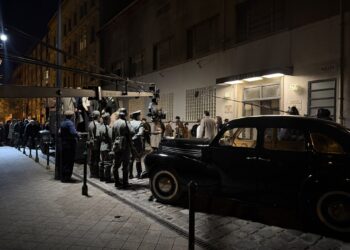
For instance, my last project was a World War II era film set in Ukraine, and we had to research everything from Ukrainian architecture of the time to street signs. In these cases, we essentially start from scratch, with the aim of not just documenting, but also infusing our own vision into the project. It’s crucial to understand the basic requirements and general context at first, and then bring in the unique atmosphere we envision for the film.
BPR: Who are the people you work most closely with on a film set?
J. Bodó: I’d break this down into two main parts. On one hand, I work very closely with the director, and oftentimes the cinematographer. The director and I have extensive discussions about the universe we want to create, the environment of the characters, and how we both envision things. It’s a creative process. And with the cinematographer, it’s also a creative, but more practical discussion about lighting the sets for example.
The other group is my own team, which includes a broader range of people like the set builders, props department, vehicles, picture backup, armoury, and many more.
Beyond that, I have a more specific art department team, which can vary depending on the size of the project. It can include one or more art directors, an assistant to the art director, and graphic designers. If it’s a big project, a lead graphic designer usually oversees the smaller team, and I mainly focus on making decisions based on the overall aesthetic of the film. I enjoy talking to people, so I don’t place much emphasis on hierarchy. I like to keep a close relationship with everyone on the team.
BPR: Does your work require you to be present on set every single day?
J. Bodó: I’m generally there at the start of the day. If a set is ready, I’ll hand it over to the director the day before, or sometimes a few days earlier depending on the size of the set. If there are last-minute changes, we discuss them and make sure they’re implemented by the next day. The morning of the shoot, I’ll check to see if everything is okay, but I usually start preparing for the next set pretty soon. I also hold classes, so my days are not uniform.
BPR: How is the strong presence of virtual production in new productions affecting your profession these days?
J. Bodó: This is a difficult question, because I don’t want to view it as competition. I believe that would be negative for the industry as a whole. We should collectively keep up the pace with these innovations. We’re on the verge of a revolution, and if we don’t adapt, we’ll be left behind. Ever since I started in film, which is almost a decade now, I have been constantly trying to keep my craft fresh. I keep track of what’s trending in 3D programs and design as well, which also includes trends in interior design. We must adapt to stay relevant in our profession.

I find it fascinating to consider how we’ll adjust in the future because my world revolves around physical objects. If that physical reality disappears and everything becomes virtual, then I’ll need to shift into conceptual design.
BPR: What are you working on right now? Can you tell us about your most challenging project so far?
J. Bodó: I started working on a production called “Nurenberg” as an art director in June. It’s another World War II film, but due to the actors’ strike, it’s currently in uncertain territory. That’s why I’ve taken up an Indian production, as I’ve always been curious about what it’s like to work on an Indian project, and I like to keep my experience portfolio as broad as I can: I have previously worked within British, Korean, Israeli, French, Spanish, German, and of course, American teams. I find that it keeps my approach more flexible.
As for my biggest professional challenge, I believe that the most exciting part of my job is that each project poses different challenges. Whether it’s commercials, series, or films, each has its unique demands. But perhaps the most challenging was an English series we filmed in Malta for five months. Each episode was set in a different country, and we had to recreate these settings on the island, which presented a multitude of challenges in sourcing materials and understanding local systems.
BPR: How do you see the quality of Hungarian productions, the effectiveness of local art departments, and our competitiveness on an international level?
J. Bodó: Infrastructure-wise, I believe that we’re pretty advanced. Foreign productions often find it strange that we have established design companies instead of assembled art department teams on an ad-hoc basis. For them, it’s inconceivable to have companies that have fully equipped ready set decoration teams for example with warehouses, trucks, and staff.
This applies to all other companies as well, like construction. These are professional, experienced teams that have often been in the business for over 30 years, and I think that could be an attractive factor for foreign productions, in addition to financial reasons.