CHINA Edition
 Hungarian Edition


Hungary is making a renewed play for the next wave of international features and premium television, with the Tisza government’s first full-year budget putting the film rebate firmly inside its 2027 production pitch. Submitted to parliament on October 30, the spending proposal retains HUF 63 billion in supplementary financing for indirect film support. For studios, independent financiers and physical-production executives planning their next European shoot, the message is continuity behind a proven production destination.
The proposition brings together three commercially important developments: international projects can again enter the incentive system following the removal of the earlier registration ceiling; the 30% rebate has a European approval horizon running through 2030; and the new government is carrying film-support financing from its revised 2026 budget into its first complete annual spending programme.
That gives Hungary a stronger platform from which to compete for the next slate. The country’s latest published registration figures already show international service production returning to a larger base, with HUF 363.1 billion recorded for 2025, up 45.1% on 2024.
A funding commitment producers can read in the budget
The relevant entry in the 2027 budget bill, T/950, appears under Chapter XLII, Title 40: supplementary financing of indirect film support under the Motion Picture Act. The proposed amount is HUF 63 billion, maintaining the provision carried into the October revision of the 2026 budget.
For a production considering a Budapest base, the significance is the place film occupies in the government’s economic priorities. Prime Minister Péter Magyar and Finance Minister András Kármán are keeping the financing mechanism behind international production inside their fiscal programme as they reshape public spending.
The HUF 63 billion entry is a financing provision that the bill allows to vary without a formal amendment. It is separate from the annual collection-account limit and from the volume of projects registered for support. Producers and their Hungarian service partners can therefore read it for what it establishes: continuing budgetary backing for the mechanism supporting the rebate.
That continuity matters well beyond an individual shoot. A studio slate is built over several years, with stage holds, construction, crew commitments and incentive receivables all feeding into the greenlight decision. Keeping the production incentive embedded in the national budget strengthens Hungary’s case at precisely that planning stage.
From reopening the pipeline to winning the next slate
The budget fits an increasingly constructive sequence. The registration restrictions introduced in 2025 created friction for incoming productions in a market whose international reputation had been built on delivery. In July 2026, the government removed the earlier aggregate registration ceiling for applications submitted after July 1, reopening the route for new projects. CMS’s account of the change sets out the practical effect for applicants.
September brought a further international signal. Deputy Prime Minister and Foreign Minister Anita Orbán called for a stable, predictable rebate framework and more international production partnerships during her visit to Canada, as Budapest Reporter reported. October’s revised 2026 budget retained the HUF 63 billion financing line. The 2027 proposal now carries that commitment into the next annual cycle.
For production executives, these are connected pieces of the same commercial proposition: access to the programme, a government commitment to the sector and an established financial mechanism supporting incoming work.
ORIGO Studios: a positive signal for international productions
“The 2027 budget proposal envisages the continuation of the tax-rebate system that supports Hungarian film production’s international success. This sends a positive signal to international productions; the scope for further growth will be determined by the final funding envelope and the predictable disbursement of rebates.”
— Mihály Tóth, Head of Marketing, ORIGO Studios
The studio perspective goes to the heart of a location decision. Producers need to connect the headline incentive to a workable production budget and a credible cash-flow schedule. The renewed policy direction gives Hungarian partners a stronger basis for those conversations with studios, lenders and completion guarantors.
The scale is already there—and the next cycle has room to grow
The National Film Office’s published series records HUF 45.1 billion in international service-production costs for 2020, HUF 189.8 billion for 2021 and HUF 346.0 billion for 2022. Following HUF 180.2 billion in 2023, the figure rose to HUF 250.3 billion in 2024 and HUF 363.1 billion in 2025.
The annual peaks reflect the scale and timing of major productions. The larger picture is a production base operating at a substantially higher level than at the start of the decade, with the latest registered total above the previous 2022 high.

Our forward illustration takes that HUF 363.1 billion base and applies 10% annual growth in each of the next two years, reaching HUF 439.4 billion in 2027—21% above 2025. It gives producers a clear picture of the scale of opportunity in another growth cycle. The scenario is an editorial extrapolation of registered production volume, separate from the budget’s financing provision.
A 30% incentive, with a runway through 2030
The underlying offer remains familiar to international producers. Hungary’s incentive provides 30% support on eligible production expenditure, with qualifying non-Hungarian costs able to lift the effective benefit to as much as 37.5% of eligible Hungarian expenditure under the programme’s rules. The National Film Institute’s incentive guidance sets out the structure and the European Commission’s approval through the end of 2030.
That multi-year horizon is useful for packages being assembled now for 2027 starts and subsequent seasons. It lets producers assess Hungary across a production cycle, combining the incentive with its established service companies, soundstages, construction departments, technical crews and locations.
The country’s screen credits make the capacity tangible. Dune, Dune: Part Two, Blade Runner 2049 and Poor Things have demonstrated what Hungarian facilities and crews can deliver across studio franchises and ambitious independent filmmaking. The commercial opportunity is to turn that accumulated experience into the next round of stage bookings and long-form production relationships.
What this means for the next greenlight
For a studio or independent producer comparing European bases, Hungary deserves a fresh place on the shortlist. The registration route has reopened, the European incentive framework extends to 2030, and the government’s first full-year budget maintains a substantial financing provision behind the system.
The practical next step is a project-level conversation with a Hungarian production partner: map eligible spend, line up the registration timetable, build the rebate receivable into the finance plan and secure the right stages and departments for the shooting schedule.
Hungary has already delivered the worlds, the crews and the production infrastructure. Its 2027 budget direction strengthens the invitation to bring the next international production—and gives the industry a constructive platform for another growth cycle.
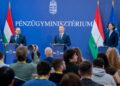
Featured photograph: Prime Minister Péter Magyar and Finance Minister András Kármán at the October 20, 2026 budget press conference, ahead of the October 30 parliamentary filing. Source: Government of Hungary / kormany.hu. Chart: Budapest Reporter, using National Film Office data and the stated growth scenario.