CHINA Edition
 Hungarian Edition


Peter Medak, the Budapest-born director whose career stretched from the savage comedy of The Ruling Class to the haunted rooms of The Changeling and the television drama Breaking Bad, has died at 88.
Medak died on October 27, 2026, in Los Angeles. His family announced his death and said he had passed away peacefully. The Hollywood Reporter reported the family’s announcement.
Known in Hungary as Medák Péter, he belonged to a generation of filmmakers whose lives were redirected by the 1956 revolution. Across six decades, his work moved between Britain and Hollywood, finding room for political satire, supernatural horror, gangster films and intimate television storytelling.
From Budapest to the British studio floor
Born in Budapest on December 23, 1937, Medak fled Hungary for England in 1956, aged 18. His route into directing began with practical work: learning the different departments of the British film industry and progressing to assistant-director assignments.
The Directors Guild of America’s career history records his early training at Associated British-Pathé and subsequent work at studios including Elstree, Pinewood and Shepperton. His credits as an assistant included The Phantom of the Opera (1962).
A contract with MCA Universal brought opportunities in television, including Court Martial. His first feature as director, Negatives, arrived in 1968, with Glenda Jackson among its cast. It was the beginning of a career in which actors would repeatedly provide the emotional centre, however extravagant or unsettling the surrounding story became.
Satire, ghosts and the criminal imagination
In 1972, Medak directed two striking adaptations of stage plays: A Day in the Death of Joe Egg, starring Alan Bates and Janet Suzman, and The Ruling Class, with Peter O’Toole.
The latter turned aristocratic England into a grotesque theatre of faith, privilege and violence. Adapted from Peter Barnes’s play, it followed a nobleman whose delusions expose the society around him. The Criterion Collection’s edition preserves the film’s full-length version, supervised by Medak. O’Toole’s performance earned a best actor nomination at the 1973 Academy Awards.
With The Changeling (1980), Medak found a different register. George C. Scott played a bereaved composer drawn into a supernatural mystery. Grief gave the ghost story its emotional weight; the house’s smallest disturbances could become instruments of dread. The film remains one of the defining titles of his career.
He later brought a formidable cast to British and American crime stories: Gary and Martin Kemp in The Krays (1990), Christopher Eccleston and Tom Courtenay in Let Him Have It (1991), and Gary Oldman opposite Lena Olin in Romeo Is Bleeding (1993). Together, those films show the range of a director comfortable with both controlled drama and feverish excess.
A familiar name in exceptional television
Medak’s television career connected several eras of popular drama. His directing credits included Homicide: Life on the Street, The Wire, House and Hannibal, alongside anthology series such as The Twilight Zone and Tales from the Crypt.
For Breaking Bad, he directed “Peekaboo,” the sixth episode of the second season. Its story brings Jesse Pinkman into a household devastated by addiction, where his encounter with a neglected child reveals a tenderness that the criminal world around him rarely permits. It is a particularly fitting television credit for a filmmaker so attentive to actors and vulnerable characters.
Returning to the scene of a difficult shoot
Late in his career, Medak turned the camera on a painful chapter of his own working life. The 2018 documentary The Ghost of Peter Sellers revisited the troubled 1973 production of Ghost in the Noonday Sun in Cyprus.
The documentary’s official website presents that return as a reckoning with a production that had haunted its director for decades. The willingness to examine disappointment became part of the work itself.
For Hungarian cinema, Medak’s story carries the history of exile. For international audiences, it survives in a remarkably varied body of work: films and television episodes that could be cruel, frightening, absurd or compassionate, often within the same scene.
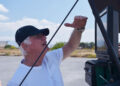
Featured image: Peter Medak checking a shot during production of The Ghost of Peter Sellers. Production photograph from the film’s official gallery.